
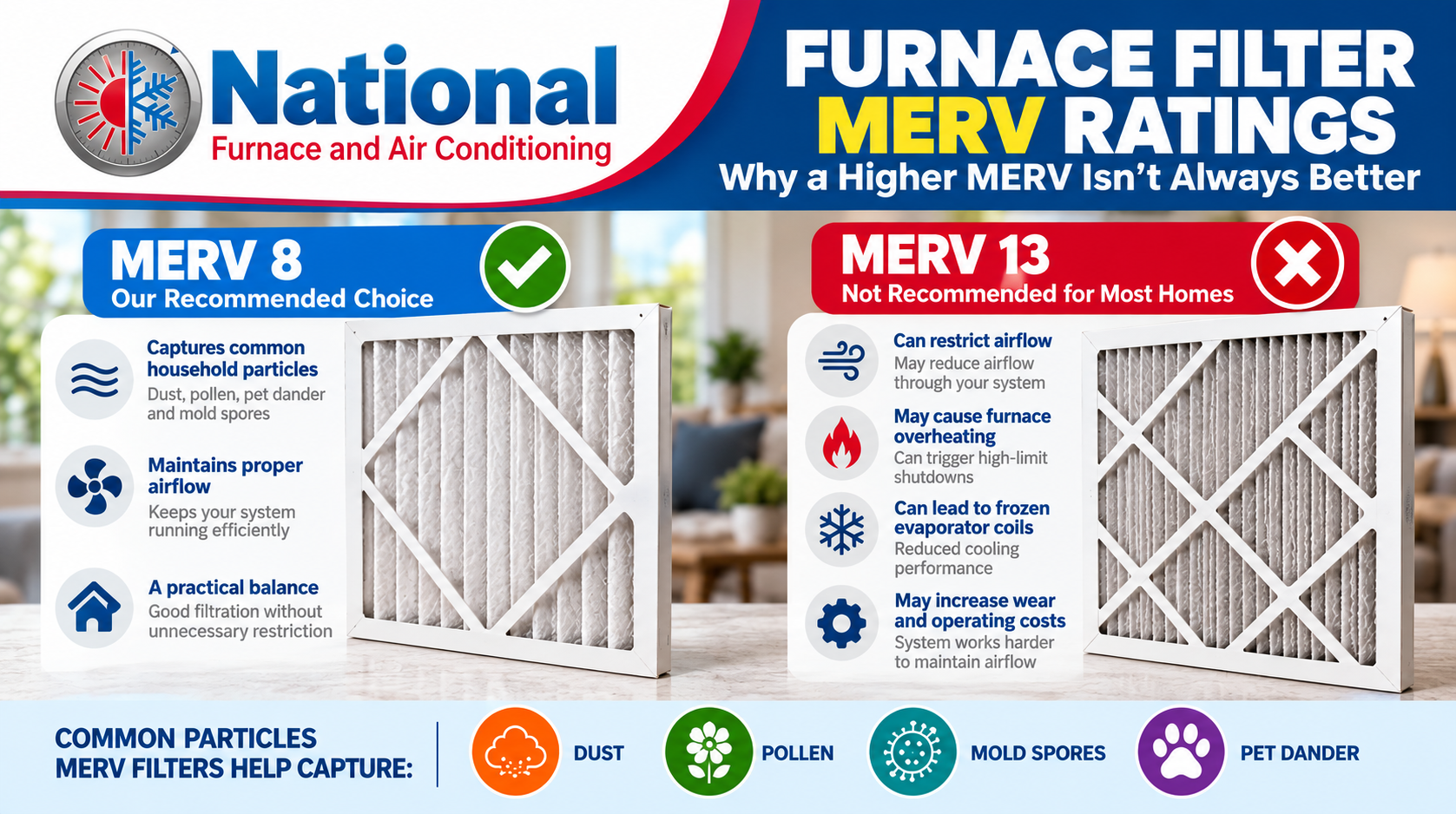
When shopping for furnace filters, you've probably noticed a wide range of MERV ratings. Many homeowners assume that the higher the MERV rating, the better the filter must be.
But that's not always true.
While higher-rated filters capture smaller airborne particles more effectively, they can also restrict airflow if your heating and cooling system isn't designed to accommodate them.
At National Furnace & Air Conditioning, we generally recommend MERV 8 filters for many standard residential HVAC systems. Here's why choosing the right filter matters more than simply buying the highest-rated one.
What Is a Furnace Filter MERV Rating?
MERV stands for Minimum Efficiency Reporting Value. It's an industry-standard rating system developed by ASHRAE that measures how effectively an air filter captures airborne particles.
MERV ratings typically range from 1 to 16 for common residential and commercial HVAC filters. Higher ratings indicate greater efficiency at capturing certain smaller particles, including dust, pollen, and other airborne contaminants.
A higher MERV rating doesn't automatically mean a better filter for your furnace or air conditioner. Your HVAC system needs proper airflow to operate efficiently and safely.
Understanding Furnace Filter MERV Ratings
Not all furnace filters provide the same level of filtration. Understanding the differences between MERV ratings can help you choose a filter that protects indoor air quality without unnecessarily restricting airflow.
| MERV Rating | Filtration Level | Our Recommendation |
|---|---|---|
| MERV 1–4 | Basic dust and lint | Minimal filtration |
| MERV 5–8 | Dust, pollen, and mold spores | Recommended for many homes |
| MERV 9–12 | Improved fine-particle filtration | Check system compatibility |
| MERV 13–16 | Higher-efficiency fine-particle filtration | Verify airflow before using |
Why We Generally Don't Recommend MERV 13 or Higher
MERV 13 filters can capture more fine airborne particles than MERV 8 filters. However, some high-efficiency filters, particularly restrictive 1-inch models, can create more resistance to airflow than an HVAC system was designed to handle.
This resistance is called static pressure. When a filter creates excessive pressure drop, it can reduce the amount of air moving through your heating and cooling equipment.
1. Reduced Airflow Throughout Your Home
A restrictive furnace filter can reduce airflow through your ductwork. This may cause weak airflow from registers, uneven temperatures, and rooms that don't heat or cool properly.
2. Furnace Overheating
Your furnace relies on adequate airflow to transfer heat safely. When airflow becomes too low, the furnace can overheat and trip its high-temperature limit switch. Repeated overheating can place unnecessary stress on the equipment.
3. Frozen Air Conditioner Coils
Your air conditioner also needs proper airflow. If insufficient air moves across the indoor evaporator coil, the coil can become too cold and develop ice buildup. This can reduce cooling performance and potentially damage equipment.
4. Higher Operating Costs
Excessive filter restriction can make your heating and cooling system operate less efficiently. Depending on the equipment, the blower may consume more electricity trying to maintain airflow, or the system may run longer to reach the desired temperature.
5. Unnecessary Wear on HVAC Equipment
Improper airflow can contribute to overheating, excessive cycling, and other performance problems that may shorten equipment life and lead to avoidable repairs.
Are MERV 13 Furnace Filters Bad?
No. MERV 13 filters can be an excellent choice when the HVAC system is designed to accommodate them.
Some homes have larger return ducts, properly sized filter cabinets, and deeper 4-inch or 5-inch media filters that provide additional filter surface area. These systems may support higher-efficiency filtration without sacrificing necessary airflow.
Filter thickness, surface area, construction, and airflow all affect resistance. A properly designed MERV 13 filter can sometimes have less resistance than a smaller MERV 8 filter.
That's why we recommend evaluating the HVAC system before upgrading to a high-efficiency filter rather than selecting one based on its MERV rating alone.
What Furnace Filter Do We Recommend?
For many conventional residential heating and cooling systems, National Furnace & Air Conditioning generally recommends a quality MERV 8 pleated filter.
MERV 8 provides a practical balance between capturing common household particles and maintaining airflow when the filter is properly sized and maintained.
However, every HVAC system is different. Some systems can safely accommodate higher-efficiency filters, while others may require less restrictive options.
How Often Should You Change Your Furnace Filter?
Even the right filter can cause problems if it becomes excessively dirty. Filter replacement depends on several factors, including household dust, pets, filter thickness, and how frequently your heating and cooling system operates.
- 1-inch filters: Check monthly and replace as needed, often every 1–3 months.
- 4-inch and 5-inch media filters: These may last considerably longer, depending on the filter manufacturer's recommendations and household conditions.
- Homes with pets or higher dust levels: Check filters more frequently.
Remember: A dirty MERV 8 filter can become more restrictive than a clean higher-rated filter. Regular replacement is essential for maintaining proper airflow.
What If You Want Better Indoor Air Quality?
If you're concerned about dust, allergies, or airborne particles, higher-efficiency filtration may be beneficial. But simply installing the highest-rated furnace filter isn't always the best approach.
A properly sized media filter cabinet, supplemental air cleaner, improved ventilation, or other indoor air quality improvements may help address your concerns while maintaining the airflow your HVAC system requires.
The Bottom Line: Higher MERV Isn't Always Better
The best furnace filter isn't necessarily the one with the highest MERV rating. It's the filter that provides appropriate particle removal while allowing your HVAC system to operate within its designed airflow requirements.
At National Furnace & Air Conditioning, we generally recommend MERV 8 filters for many standard residential systems and suggest having your equipment evaluated before switching to MERV 13 or higher.
Not Sure Which Furnace Filter Is Right for Your Home?
National Furnace & Air Conditioning has been helping homeowners in Lincoln and surrounding communities with their heating and cooling needs since 1992.
Our experienced technicians can evaluate your system's airflow and help you choose a filter that supports indoor air quality without creating unnecessary restrictions.
Prefer to call? 402-436-3492